Text for speech I gave at the SACC/IHRC Islamophobia Conference in Glasgow on 14 December 2025. The speech I gave differed slightly from the text.
At last week’s Islamophobia Conference in London we talked Government attacks on acts of conscience. There’s no sharper example than what’s happening to Palestine Action activists.
The people going through the courts now were arrested over events that happened before Palestine Action was banned. They acted out of conscience to try to stop weapons being exported to Israel in violation of Britain’s obligations under the Genocide Convention.
If they had acted for fun or money the Government would not treat them so harshly. Many of them have been on remand for far beyond than the usual limit in England and Wales of 6 months. Where people are accused of apolitical, conscienceless crimes judges are usually reluctant to extend remand beyond 6 months.
A few weeks ago a judge in England refused to extend remand for a man charged with attempted murder. The victim’s injuries were said to be life-changing and the defendant was said to pose risks of reoffending, absconding, and interfering with witnesses. But because his trial could not be listed until June 2026, the judge ordered his release on bail.
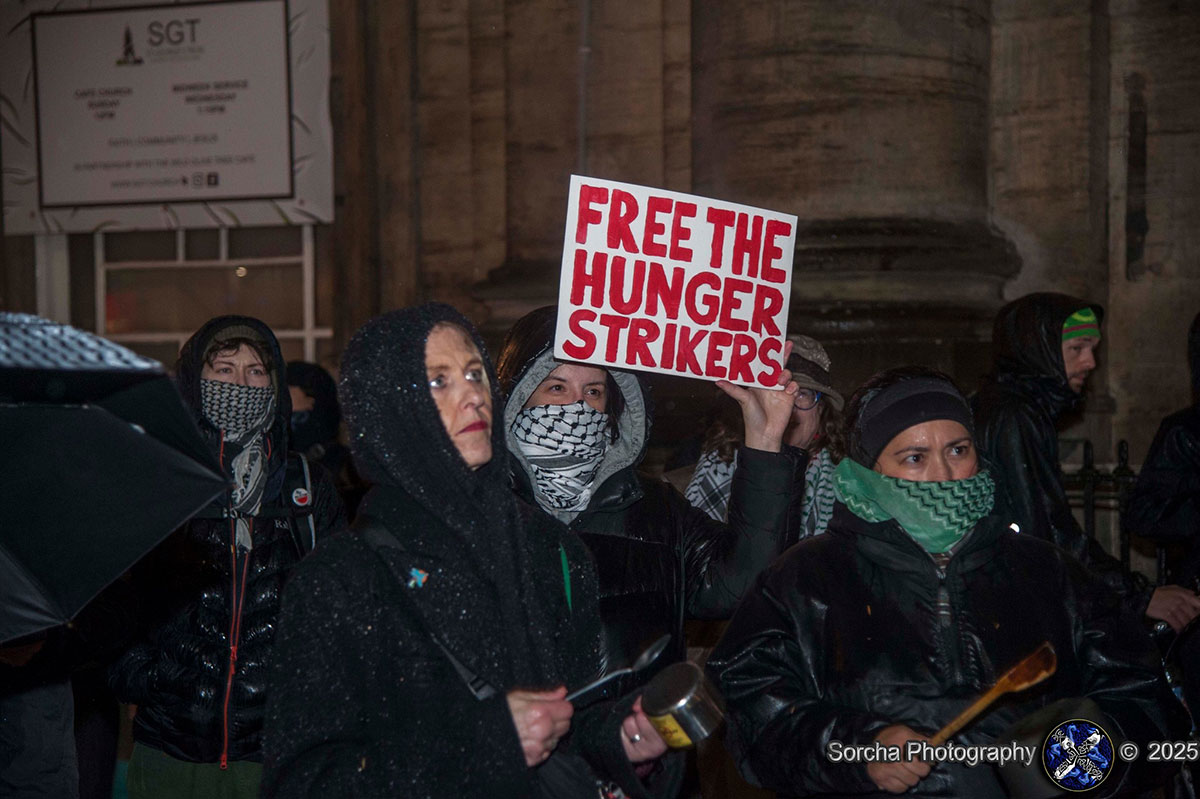
Now 8 Palestine activists are on hunger strike. The Government refuses to even talk about the situation. It’s a cold-eyed attempt at murder, no better than the torture by force-feeding that suffragettes and Guantanamo prisoners were subjected to.
anti-racism is always dissent
Our London conference talked about dissent. We often forget that in Britain anti-racism is always dissent. We forget because decades of campaigning have forced governments to adopt some policies against racism, which we then have to defend from attacks from the right. But racism is still embedded in British institutions and the British state.
If you doubt that, just look at how determined both Labour and Tories have been to help Israel carry out its genocide in Gaza. Or if you want to see it up close and personal, look at what the way the public inquiry into the death of Sheku Bayoh is being derailed.
In forgetting that anti-racism is dissent, we open the door for racist agitators to persuade people doing badly in our society that attacking immigrants and minorities is a way of attacking government.
Racists are inciting people to protest outside asylum hotels. I’d like to protest about asylum hotels too.
I want to protest against asylum-seekers being isolated in hotels instead of being housed in our communities, against the denial of their right to work, the denial of their right to mainstream welfare, against the mean-spirited asylum welfare system.
We need to win the battle of numbers outside asylum hotels and isolate the agitators from the rest of the community but we need to walk and chew gum at the same time. If to do that we give ground and describe racist concerns as legitimate concerns, we might possibly win the battle but we’ll certainly lose the war. We need to take the initiative.
We need to involve masses of people not just in turning up to counter protest against comic-book thugs, but in active solidarity with asylum-seekers, in campaigns to roll back the juggernaut of anti-immigration legislation.
That’s how we build communities that fascists can’t penetrate. It’s how we kill the myth that fascist are edgy and anti-establishment. It’s what reclaiming the resistance means.
Our collective conscience lives mainly in the Palestine solidarity movement.
The movement’s recent past isn’t beyond criticism. Too often we tolerated untenable positions that our would-be friends in professional politics said they had to adopt, like their insistence on asserting Israel’s fictional right to defend itself against occupied people. Politicians presented that position as incontrovertible, but what they said was at best untrue and at worst an attempt to create customary intentional law to suit Israel.
But once the intensified genocide that followed October 7 was under way, people listened to their conscience and stood against it. That’s a precious gift to our collective political culture. We mustn’t squander it.
Palestinian liberation will be won by none other than Palestinian hands
Building on it means recognising that Palestinian liberation will be won by none other than Palestinian hands.
Of course Israel’s nature as an outpost of the West means that Palestinians can’t free themselves without support around the world. But if Palestine’s future isn’t made by Palestinians, it isn’t liberation.
If it doesn’t include full respect for Palestinian political rights, including the right of return, it isn’t liberation.
If it doesn’t bring an end to the power structures that have created a racist, genocidal political culture in Israel, it isn’t liberation.
Whether there are two states or one state or seven, if any of them are apartheid states it isn’t liberation.
As far as the Palestinian territories internationally recognised as occupied are concerned, we need to continue to uphold the right, as recognised in international law, of the Palestinian people to engage in resistance, including armed resistance. And of course alongside that right there’s an obligation on all sides to respect international humanitarian law.
We should not accept that any of these positions are marginal ones that our elected representatives in Parliament can’t be expected to support. If we accept that, we’re letting them use our struggle for their goals.
It’s often said that the ban on Palestine Action is unique because it’s the first time a non-violent organisation has been placed under a terrorism ban. The situation around Palestine Action is unique in various ways, but that’s not one of them. The honour of being the first non-violent group to be banned belongs to Hizb ut Tahrir.
They were banned in 2024, apparently because of articles they published that took a positive view of the 7 October Hamas incursion into Israel.
In fact they’ve been on a wish-list for years of groups that right-wingers wanted to ban, mainly because other countries, where Hizb ut Tahrir is an oppositional movement, wanted them banned. The banning system under the Terrorism Act 2000 is mainly a way for British governments to help their overseas friends and that’s why Hamas and Hizbollah and now Palestine Action were banned. It has nothing to do with protecting the British public. The whole system of proscription under the Terrorism Act 2000 should go.
The articles about 7 October were the excuse for banning Hizb ut Tahrir. But it should have been a warning that free speech is under attack. There’s no better word than Islamophobia to describe the lack of an outcry about it.
Hizb ut Tahrir has always been extremely law-abiding in the UK. When the ban came into effect it vanished. Maybe that’s why the Government thought they could erase the idea of Palestine Action by banning it.
Islamophobia is one of the ways that civil society has been degraded. I’m not asking non-Muslims to stand against Islamophobia just out of their own self-interest, because that’s a bad starting point. I am asking everyone to realise that the old slogan “an attack on one of us is an attack on all of us” is exactly correct and to remember that “us” includes Muslims.
Photo: Protestors support the hunger strikers while banging pots for the hungry people of Gaza, Nelson Mandela Place, Glasgow, 18 December 2025