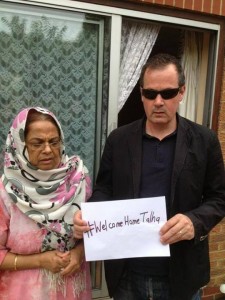
Fathers of Talha (right) and Babar (left) on day of extradition

The  Comment is Free section of the Guardian website has become an institution. It looks and feels rather like a collection of blogs, hosted and moderated by the Guardian. The Guardian gets to choose who writes there, and gets to set the moderation policy. It gains readers and web presence.

Fair enough. But the Guardian also gets editorial control. In other words, it determines what its contributors appear to have said. Comment, like lunch, is never really free. Or even as moderately-priced as you think it is. There are hidden extras.

A headline can make all the difference in the world to what readers think an article says. Social media have increased the premium on the headline.

The headline is what you mostly notice when an article is posted on facebook or twitter. A lot of people will “like” or re-post without reading the article, based simply on the headline. A headline can boost a campaign or sink it. It can kick a vulnerable person where it hurts, or bring a smile of relief.

The headline that the Guardian attached to an excellent recent article about Babar Ahmad and Talha Ahsan was the kind that does damage. It was misleading and factually inaccurate (it was corrected on 8 August).  I sent the following protest about it to the Guardian’s readers’ editor, Chris Elliot:
Continue reading

Mark McGowan with Talha Ahsan's mother
“The Artist taxi-Driver” Mark McGowan with Talha Ahsan’s mother

Talha Ahsan was “freed” by a US court on 16 July, 20 months after being extradited from Britain to face terrorism charges. But he still isn’t quite free. His UK passport has expired, so he is now in immigration custody in the US waiting for the British authorities to supply a new one.

The judge’s decision raises serious questions over the long persecution of Talha Ahsan and co-defendant Babar Ahmad by the British and US authorities.

Talha Ahsan has been in jail for 8 years, and Babar Ahmad for 10 years. For most of that time they have been held without charge in high security prisons in Britain. They were extradited to the US in October 2012, where they were finally charged with terrorism offences.

Continue reading

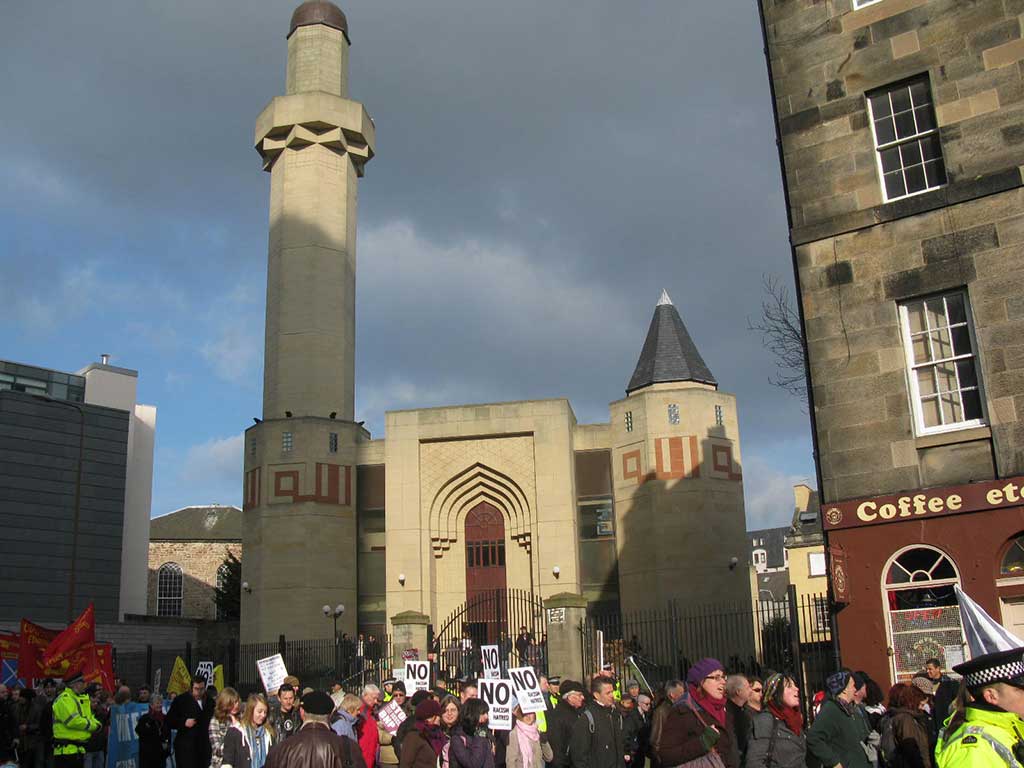
Demo against the SDL, Edinburgh, 20 February 2010

A teenage girl and a 39-year old man who desecrated Edinburgh Central Mosque with strips of bacon have been given custodial sentences at Edinburgh Sheriff Court.

Both of them were said in court to be linked to the SDL. Richard Dawkins called the sentences “law gone mad.” Richard Dawkins is sometimes an idiot. But I have serious reservations of my own about the sentences.

I visit Edinburgh Central Mosque from time to time. It is normally a pleasant experience, so it is upsetting to hear about this kind of abuse. But I am not a religious person. My feelings are a poor guide to the impact of the incident on Muslims.

To devout atheists like Richard Dawkins, I’d begin by suggesting a simple mental exercise. Think of a place of natural beauty to which you are particularly attached. Then think of finding one day that rubbish of an especially obnoxious kind has been dumped there. Add to that the way that you would feel if rubbish that you and your family find particularly disgusting had been left inside your home, with the clear intention of causing you distress.

This sort of mental muscle-flexing would be an interesting exercise, and maybe even kind of important, if we lived in a parallel universe where racism, colonialism and fascism didn’t exist. Now let’s return to our own world. Continue reading

A few days ago I referred to J K Rowling in slightly rude – but I think rather apt – terms after she gave £1 million to the Better Together Campaign. I wasn’t the first person to do so, and some people may have used less appropriate language than I did. Now it turns out that the police are “considering” a report of online crime  in relation to Saint Rowling, and the Crown Office has said that it will prosecute over “grossly offensive” remarks.

My article was mainly intended to draw attention to the difficulties that are apt to arise as a result of political action by an individual with extreme levels of wealth and influence. I also wished to highlight the related question of the way that public figures and the media can manipulate people’s perception of events around them. The notion that anti-English hatred is a significant feature of the campaign for Scottish independence was first popularised by Nigel Farage, has been seized upon by some members of the No campaign (including J K Rowling) and seems to be gaining a spurious credibility that I do not think is rooted in day-to-day experience.

J K Rowling is richer than the Queen. Her economic and political clout, like the Queen’s, is probably even greater than her personal wealth would suggest. The Harry Potter brand was valued in 2011 at $15 billion, a figure that dwarfs J R Rowling’s personal fortune of £570 million. She appears to be well-connected politically. The fact that her primary industry is entertainment, rather than say uranium-mining, potentially eases her path to public influence. So do her charitable activities, which include support for the Anne Rowling Regenerative Neurology Clinic at Edinburgh University. She is an institution as well as a person. Continue reading

Harry PotterSo now we’ve got the glamour and financial muscle of J K Rowling to reckon with. A million quid. Whew!

I’m told JayKay writes a bit. She’s intelligent, urbane and – up to a point – well informed. She has carefully set out on her blog her reasons for backing the campaign against Scottish independence. So of course I won’t stoop to abuse. I’ll set out, in a measured way, my reasons for disagreeing with her.

Like hell I will.

You want that, you visit the National Collective website and read the open letter by Mairi McFadyen. Or read Pat Kane’s article in the Independent .

J K Rowling’s intervention is a piece of high-class thuggery. I’ll respond the way you do when you can’t pay for class.

Continue reading

Petro Poroshenko and John Kerry, Warsaw, 2014

Petro Poroshenko’s inaugural speech as President of Ukraine was bad news for the people of Ukraine, and perhaps for the rest of us too. Of course it was upbeat. And of course he said he wanted peace. Warmongers always do. But it was the speech of a leader determined upon civil war

He offered an amnesty to those “who illegally took weapons in their hands”. But he excluded those who “have blood of Ukrainian soldiers and civilians on their hands”.  He made no mention of supporters of the Kiev regime who have blood on their hands.

And he excluded those “involved in funding terrorism”. So billionaire Petro Poroshenko wishes to jail rival oligarchs, especially Viktor Yanukovych and what he called the “clan of Yanukovych”. No surprise there.

He offered nothing likely to make Ukrainians who are hostile to the Kiev regime or suspicious of it feel happier about their future.

Continue reading

JOINT STATEMENT BY THE KURDISH COMMUNITY OF THE UK

30 May 2014

KURDS FOR AN INDEPENDENT SCOTLAND

On 18 September 2014, the Scottish people have an opportunity to determine their own future as an independent country in a free vote. The choice that they make in this independence referendum will influence the lives of future generations. Furthermore, the result will have a profound impact on the fortunes of peoples throughout the world – the Kurds included – who hold similar aspirations to take greater control of their own lives and who are seeking to determine their own futures.

At stake are not borders, national flags or emblems, but whether free people have the right to decide their own futures in a democratic state. It is for this reason that the Kurds will be watching closely the vitally important developments unfolding in Scotland over the next few months. Continue reading

Nigel Farage doesn't speak for me
Well, that was a disappointment, wasn’t it? Of course I’m talking about UKIP’s acquisition of a Scottish seat in the European Parliament. A UKIP-free Scotland would have been a nice badge for us. Maybe some tactical voting could have done it.

But forcing UKIP just below the threshold they needed was never much of a badge to aim for. We should have trounced and humiliated them and stripped them of their deposits. It isn’t a terrific surprise that we failed. In view of the assistance that UKIP received from the media, the real surprise is that they didn’t walk off with a brace of Scottish seats.

The late Screaming Lord Sutch of the Official Monster Raving Loony Party could probably have secured a Strasbourg seat if the media had treated him with the seriousness they showed towards Nigel Farage. He would certainly have done a much better job than David Coburn, our new UKIP MEP, is likely to do.

UKIP is not a party of eccentrics or a protest party. It is a racist party. Some of the people who voted for UKIP might not see themselves as racist. But they must have noticed the anti-immigrant message on UKIP posters and leaflets.  They must have either agreed with the message or thought it unimportant.

Continue reading

Protest outside the US Consulate, Edinburgh, 11 Jan 2007A year ago today, President Obama launched the most recent of his initiatives to close Guantánamo. He was speaking at the National Defense University at Fort McNair, Washington DC. It was an awkward moment for a major defence policy speech.

Drone strikes had put a strain on US relations with Pakistan. For nearly 6 weeks, the US had been observing an undeclared drone ceasefire in Pakistan, apparently out of respect for the elections there. The end of the ceasefire was less than a week away. At Guantánamo, the prisoners’ hunger strike was at a peak and had received a good deal of media attention. So a careful speech was needed, combining robust defence of US policy with a convincing acknowledgement of the suffering that it created.

Barack Obama’s speech was a good one, in its way. The kind of speech that a patriotic but idealistic student might have delivered in a debate at an Ivy League university.

Maybe Obama’s speechwriters don’t spend too much time talking to his policy advisers.

Continue reading